
Key Takeaways
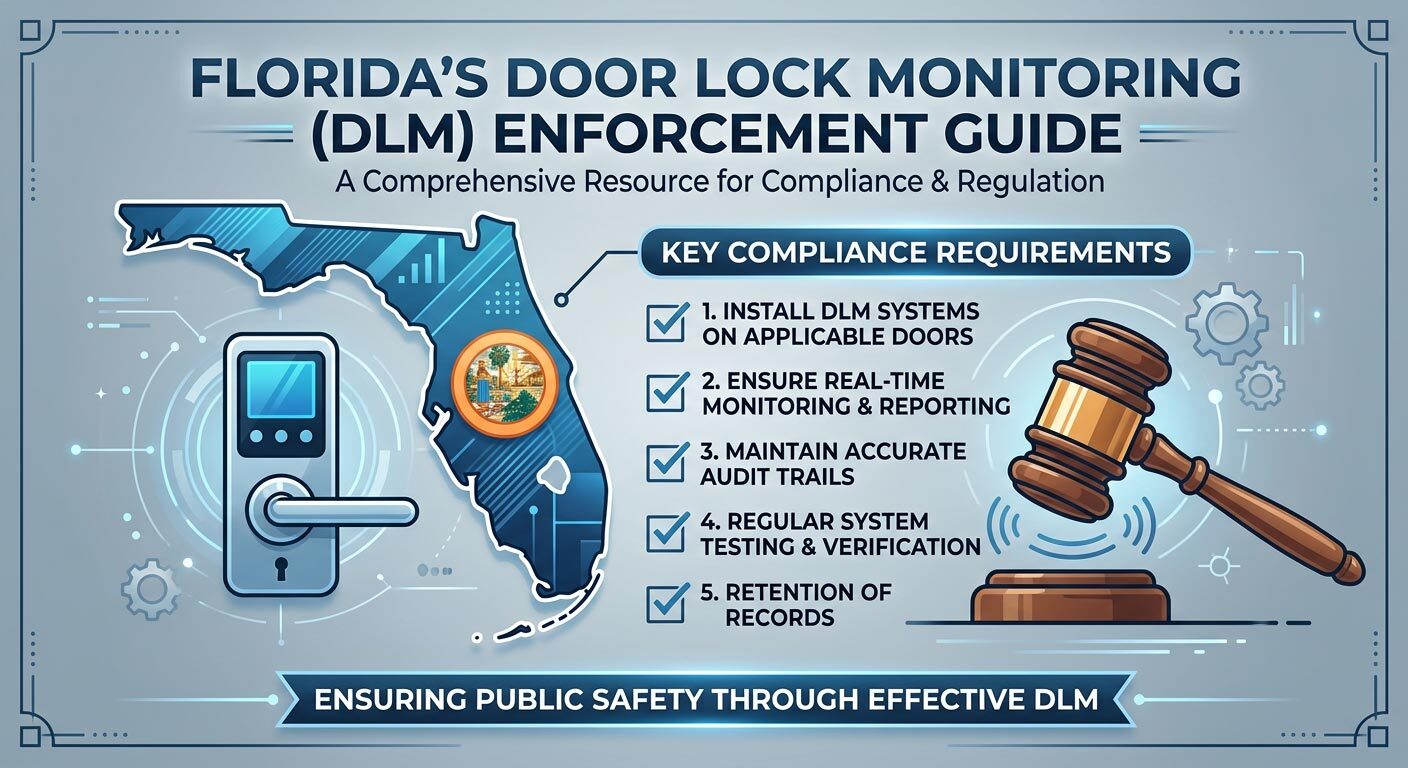
- Strict Florida Mandate: The Florida DBPR active enforcement requires all automatic passenger elevators installed prior to October 2000 to feature functional Door Lock Monitoring (DLM) under ASME A17.3-2015.
- Severe Penalties: Failing an annual inspection triggers an official state code violation, giving property owners 90 days to comply before facing administrative fines of up to $1,000 per violation and potential equipment shutdown.
- Avoid Expensive Modernizations: Elevator OEMs and large corporations frequently push $50,000 to $100,000+ full controller modernizations, claiming older units cannot be retrofitted.
- The Cost-Effective Overlay Alternative: Peak Elevations installs UL-listed external overlay modules that interface with existing equipment, satisfying state codes at a fraction of the cost.
- Fast Turnaround: External overlay installations typically take 1 to 3 days to complete and inspect, compared to weeks or months of downtime for complete modernizations.
_________________________________________________________________________________________________________
Florida elevator compliance has shifted from a distant regulatory concern to an active enforcement reality. Commercial property managers and condo board directors across the state are opening their mail to find official citation paperwork from the Florida Department of Business and Professional Regulation (DBPR) Bureau of Elevator Safety.
If your building’s passenger elevators were installed prior to October 2000, you are likely facing an urgent demand to install a functional Door Lock Monitoring (DLM) system.
To make matters worse, many property managers reaching out to their original equipment manufacturers (OEMs) or big corporate elevator providers are being handed six-figure proposals for total controller modernizations.
You do not need to tear out your central controller to satisfy state inspectors. Achieving DLM compliance in Florida can often be accomplished cleanly, quickly, and affordably without a full system overhaul.
Decoding Florida’s Door Lock Monitoring Code
To resolve an elevator violation, it helps to understand what the state is inspecting. Under Florida elevator regulation updates, the DBPR adopted ASME A17.3-2015, specifically Section 3.10.12. This retroactive safety standard mandates that all existing automatic passenger elevators must continually monitor the integrity of their door position circuits.
What standard Door Lock Monitoring actually does
- Monitors Circuit State: The system checks the condition of the hoistway door interlocks and the car door gate switches.
- Detects Faults and Bypasses: If an electrical short occurs or if a door contact switch is manually bridged/bypassed, the system detects the anomaly.
- Prevents Unsafe Motion: Upon detecting a fault, the DLM system removes power from the driving machine and brake, keeping the elevator safely parked at the landing until a certified technician clears the fault.
While newer elevators built after October 2000 generally came with factory-installed DLM features, tens of thousands of older units operating in Florida rely on electro-mechanical relay logic controllers that lack built-in monitoring circuitry.
What is the penalty for missing the DLM compliance deadline in Florida?
Properties operating automatic passenger lifts without a functional Door Lock Monitoring system will fail their annual St. Petersburg elevator inspection. The Florida DBPR will issue an official code violation, initiating a strict 90-day countdown to correct the issue or face ongoing state administrative fines of up to $1,000 per violation, and potential equipment shutdown.
The Modernization Trap vs. The Engineering Reality
Receiving notice of elevator inspection violations in Florida creates immediate financial and operational pressure. When board members and building managers ask their current service providers for elevator citation resolution, big multinational elevator conglomerates frequently offer only one solution: a complete controller modernization.
These sales proposals argue that because your 1980s or 1990s microprocessors or relay logic panels lack native DLM software, the entire central brain of the elevator must be ripped out. Quotes for these full modernizations routinely range from $50,000 to over $100,000 per lift, with lead times stretching into several months.
This “rip-and-replace” strategy serves the sales targets of large corporations, but it rarely serves the financial interests of building owners. If your existing elevator controller is otherwise reliable, dependable, and well-maintained, replacing the entire control system solely to add a door circuit monitoring loop is an unnecessary expense.
The Peak Elevations Solution: Smart External Overlay Modules
Achieving code compliance does not require rebuilding your elevator from scratch. Peak Elevations brings a practical, electro-mechanical perspective to regulatory upgrades, backed by founder William Peak’s 30 years of hands-on expertise with legacy and modern elevator systems.
Instead of pushing costly modernizations, Peak Elevations utilizes state-approved, UL-listed external DLM overlay modules.
How External Overlay Modules Work
- Targeted Integration: A compact, self-contained DLM control box is mounted adjacent to your existing elevator controller.
- Circuit Interface: The unit interfaces directly with your car door contacts, landing interlocks, and direction signals without disrupting the underlying drive logic.
- Stand-Alone Monitoring: The overlay module performs the exact fault checks required by ASME A17.3 Section 3.10.12, cutting power to the safety circuit whenever a short or bypassed contact is detected.
Benefits of the Overlay Approach
- Cost Savings: External overlay installations typically cost a fraction of a complete controller replacement, saving properties tens of thousands of dollars per elevator shaft.
- Minimal Downtime: Full modernizations can take weeks or months to complete. An overlay installation is generally completed and inspected within 1 to 3 days, minimizing service disruptions for your residents and tenants.
- Turnkey Compliance: Peak Elevations handles the entire process, from pulling required DBPR alteration permits to performing final acceptance testing with certified inspectors to clear your citation.
Protecting Your Building’s Operating Budget
If your property has received an inspection notice or you are unsure whether your current system meets state requirements, do not assume a full modernization is your only option.
Start by gathering your recent inspection reports and checking the manufacturing date on your controllers. For units installed between 2000 and 2015, compliance may simply require activating dormant software or adjusting relay settings. For older systems, an engineered overlay module provides a direct path to meeting the door lock monitoring code while protecting your reserve fund.
Frequently Asked Questions (FAQs)
What is Door Lock Monitoring (DLM) and why is it required in Florida?
Door Lock Monitoring is an elevator safety feature that continuously checks whether the car and hoistway door interlocks are functioning properly. It prevents the elevator from moving if door safety circuits are bypassed or bridged. Florida requires DLM retrofits under ASME A17.3-2015 (Section 3.10.12) to prevent dangerous unintended car movement while doors are open.
Which elevators in Florida are subject to the DLM mandate?
All automatic passenger elevators installed prior to October 2000 must be retrofitted with a compliant Door Lock Monitoring system. Elevators installed after this date generally came equipped with DLM capabilities from the factory, though software activation or parameter adjustments may still be required.
Do I have to replace my entire elevator controller to comply with DLM codes?
No. While many big elevator companies recommend full controller modernizations costing $50,000 to $100,000+, you can often achieve full code compliance by installing a UL-listed external DLM overlay module. This stand-alone system interfaces with your existing controller without requiring a complete overhaul.
How long does it take to resolve a DBPR elevator citation using an overlay module?
Once permits are approved by the Florida DBPR, installing an external DLM overlay module typically takes between 1 and 3 days per elevator. Peak Elevations then coordinates state-certified acceptance testing to officially clear your citation within your 90-day cure window.
What happens if my building ignores the DLM compliance citation?
Failing to correct a DLM violation within the state-mandated 90-day window can result in DBPR administrative fines of up to $1,000 per violation, ongoing daily penalties, and the revocation of your elevator operating permit, which forces equipment shutdown.
Navigating state mandates requires transparent, expert guidance focused on solving the problem at hand.
Contact Peak Elevations today to schedule a technical assessment of your elevator controllers and discover how simple, targeted engineering can bring your building into full compliance.
